
Forming -> Storming -> Norming -> Performing
With the Brisbane Olympics on the horizon, more organisational leaders are wanting high-performing teams. But it’s fair to say that many professional teams are not there yet.
All teams have their issues – some teams are new. Some are stuck in tension. Some are busy but unclear. Others may need to lift trust, communication or even performance.
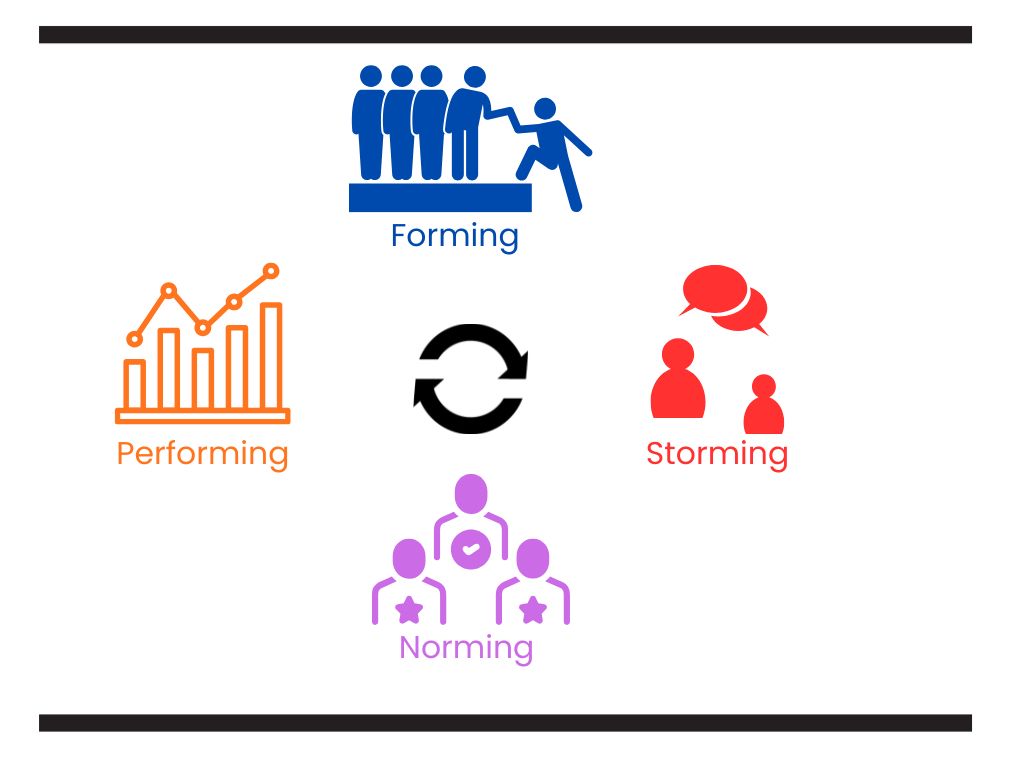
Bruce Tuckman’s Team Development model gives leaders a practical lens to understand where their team is now – and what support may help to move it forward. The four stages* – Forming, Storming, Norming and Performing – remain a widely used way of explaining how teams can develop over time.
Its value lies in the model’s simplicity: teams typically move through each stage, and they each come with their own challenges. What matters for leaders is being able to recognise the relevant stage and respond appropriately!
*Several years later (1977) Tuckman did actually introduce a 5th stage to his model
– Adjourning – where the team completes the task and breaks up the team.
Forming: polite, positive… and uncertain
In the Forming stage, people are often courteous and cooperative. But beneath that early goodwill, there can be uncertainty around expectations, roles, priorities, and how the team is meant to work together.
A team in Forming may look calm but still lack clarity.
This is often where leaders notice that people are not yet fully connected. Individuals may still be operating from their own habits, assumptions or previous team experience. The team exists, but cohesion has not yet formed.
Storming: when tension starts to surface
The Storming stage is where personal differences become more visible. Communication styles clash. Priorities compete. Assumptions get tested. Frustrations rise. In modern workplaces, this can be intensified by remote work, intergenerational expectations, role ambiguity, and pressure on time and resources.
Storming is not necessarily a sign of failure. In fact, it is often a normal part of team development. The issue is whether the team has the trust and communication needed to move through this friction productively.
This is often where low cohesion shows up most clearly. People may be polite in meetings but not open outside of this. Conflict may be avoided, delayed or expressed indirectly. Trust becomes patchy, and collaboration feels harder than it should.
Norming: shared ways of working start to emerge
In the Norming stage, trust begins to strengthen and the team develops more consistent ways of working. Expectations become clearer. People understand each other better. There is more willingness to adapt, communicate openly and work towards shared priorities.
This is where teams begin to move from individual preferences to collective rhythm.
But not every team reaches this stage smoothly. One common reason is that team direction is unclear. People may be working hard, but not always towards the same future state. Strategy may exist at leadership level but not be translated clearly into operational priorities. In remote teams, that lack of shared direction can be even more pronounced.
Performing: aligned, capable and productive
In the Performing stage, the team is not perfect – but it is effective. There is stronger trust, greater role clarity, more constructive handling of conflict, and better focus on outcomes. Energy is directed less towards internal friction and more towards delivery.
This is where the question often shifts from cohesion and clarity to productivity.
Sometimes a team has a sound plan and capable people but still needs a jumpstart in performance. That is often because productivity is not just about systems or process.
It is also about emotional climate. Leaders must balance confidence with empathy. Team members need to read the room, manage pressure, handle difficult conversations and respond well to others.
So, where’s your team now?
Does your team have any of these issues:
- Low cohesion and patchy trust?
- Unclear direction and inconsistent buy-in?
- Flat productivity despite good intent?
If so, the right workshop can help.
Issue 1: Low team cohesion and patchy trust
Edmonds Facilitation’s Team Building Workshop (with Extended DISC®) is designed for exactly this kind of challenge – helping teams understand behavioural styles, improve communication and build stronger working relationships.
This workshop is especially valuable for cross-functional teams, new teams, developing teams and groups experiencing conflict. It is designed to improve cohesion, trust and team performance.
Issue 2: Unclear direction and inconsistent team buy-in
Edmonds Facilitation’s Team Planning Workshop (Charter on 1 Page) can be especially valuable when team direction is unclear.
This workshop is designed to involve people in the development of their operational plan, helping teams interpret goals, connect their work to organisational priorities and increase buy-in. The Team Charter on One Page framework is intended to clarify team purpose, priorities, roles and responsibilities.
Issue 3: Flat team productivity despite good intent
Edmonds Facilitation’s Emotional Intelligence Workshop (using Genos) is ideal for teams needing to lift communication, empathy and performance.
Using the Genos model, this workshop helps teams build self-awareness, improve communication, manage emotions under pressure and strengthen collaboration. It is designed to provide shared language, data-driven insight and practical tools to improve workplace relationships and performance.
The good news
These issues are not unusual. And they are not usually fixed without some difficult conversations.
And with the right support, teams can build stronger rapport, greater clarity and better performance.
If your team is experiencing any of these challenges below, it may be time to step back and diagnose what is really going on.
- Low cohesion and patchy trust?
- Unclear direction and inconsistent buy-in?
- Flat productivity despite good intent?
If your team is stuck in tension, unclear on direction, or capable but not yet performing at its best, now is the time to act.
Edmonds Facilitation can help your team build stronger cohesion, clearer alignment and better performance.
Reach out today to start the conversation.